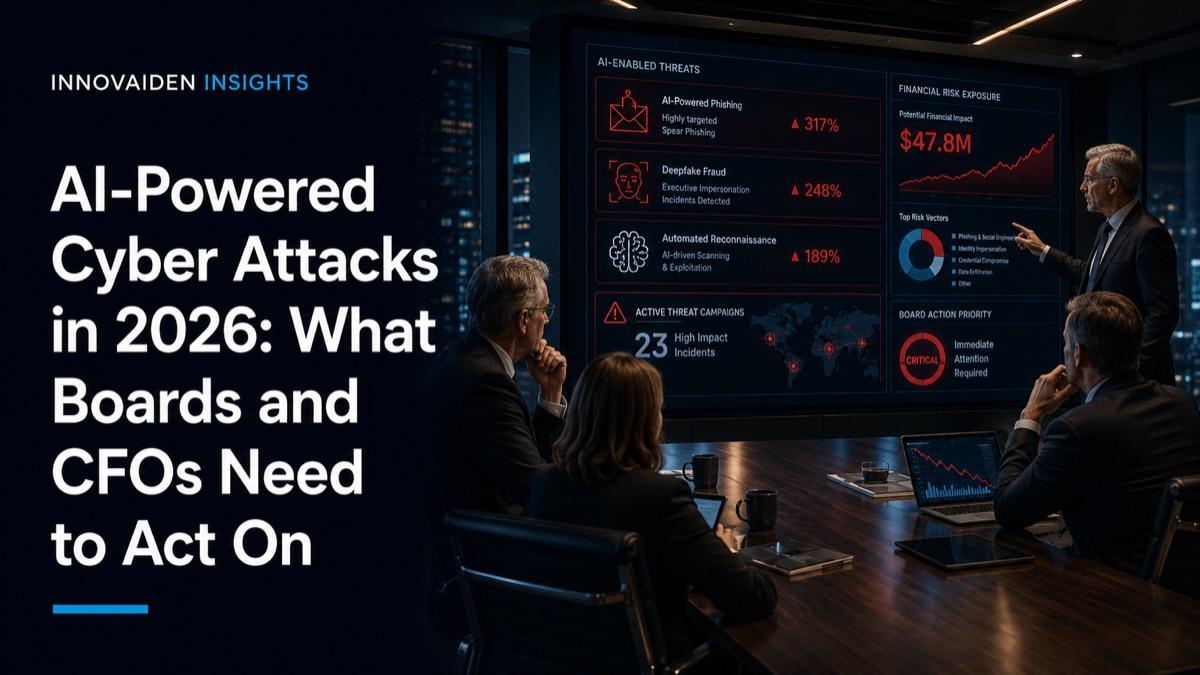
AI-Powered Cyber Attacks in 2026: What Boards and CFOs Need to Act On
Cyberattacks in 2026 are cheaper to launch, harder to detect, and more convincing than anything boards were briefed on five years ago. Artificial intelligence has not created a new category of threat. It has made every existing threat faster, more targeted, and more effective. The phishing email that once took a sophisticated attacker hours to craft now takes seconds. The voice on the wire transfer call that sounds like the CFO may not be.
This briefing is written for directors and finance leaders, not security teams. It covers the three AI-powered attack types generating the most losses for mid-market companies today, the 12 controls that close the most critical gaps, and the questions worth raising with your CISO before your next board meeting.
Key Takeaways
- The average cost of a data breach reached $4.88 million in 2024, a 10% increase year-on-year (IBM Cost of a Data Breach Report, 2024)
- Business email compromise (BEC) accounted for $2.9 billion in reported US losses in 2023, making it the top category by financial loss (FBI Internet Crime Report, 2023)
- 68% of breaches involve a human element: phishing, stolen credentials, or social engineering (Verizon DBIR, 2024)
- Deepfake voice synthesis capable of impersonating an executive costs less than $500 in compute time and requires only a few minutes of publicly available audio
- Mid-market companies with revenues between $50M and $500M face disproportionately high ransomware targeting relative to their security investment levels
Three AI-Powered Threats Generating Real Losses in 2025 and 2026
AI-enhanced phishing and business email compromise. Traditional phishing works on volume: send enough generic emails and some percentage of recipients will click. AI-powered phishing is different. Large language models generate targeted, contextually accurate messages using publicly available information about the recipient: their role, recent company announcements, vendor relationships, and communication style. The result is a message that passes organizational gut-check tests that previously caught most attacks. Security awareness training built for the last generation of threats does not detect this one.
Deepfake voice and video fraud. In 2024, a multinational company lost $25 million after a finance employee was convinced by a deepfake video call to authorize a fraudulent wire transfer. The call appeared to include the company's CFO and other senior executives. Voice synthesis tools now require fewer than three minutes of source audio to produce convincing real-time voice replication. Any executive with a podcast appearance, investor call recording, or media interview is a potential source. This is not a theoretical risk.
AI-accelerated vulnerability exploitation. The time between a software vulnerability being publicly disclosed and active exploitation has compressed from weeks to hours. AI tools help attackers rapidly scan for, identify, and exploit known vulnerabilities in internet-facing systems before security teams can patch. Companies running legacy software or unmanaged third-party integrations are disproportionately exposed.
Frontier-model vulnerability discovery at scale. In April 2026, Anthropic's Project Glasswing demonstrated that frontier AI systems can discover thousands of previously unknown vulnerabilities in mature codebases — many in software that had survived decades of human review. The same capability that lets defenders pre-emptively find and patch issues lets attackers find and weaponize them. The deployment asymmetry is what should concern boards: defenders need every issue patched; attackers need only one. Even with responsible disclosure, the patching gap is wide — fewer than 1% of Mythos-discovered vulnerabilities have been patched as of mid-2026.
| Attack type | How AI changes it | Documented exposure |
|---|---|---|
| AI-enhanced phishing and BEC | LLMs generate hyper-targeted messages in seconds; bypasses standard awareness training | $2.9B in reported US losses, 2023 (FBI IC3) |
| Deepfake voice and video fraud | Under 3 minutes of source audio enables real-time executive voice cloning | $25M single-incident loss, 2024 |
| AI-accelerated vulnerability exploitation | Exploit window compressed from weeks to hours after public disclosure | Legacy and unpatched internet-facing systems disproportionately exposed |
| Frontier-model vulnerability discovery | AI finds thousands of zero-days in mature codebases; patching lags discovery | Under 1% of Mythos-discovered vulnerabilities patched (Apr 2026) |
Why Mid-Market Companies Are the Primary Target
Enterprise organizations with mature security programs have raised the cost of attack. Mid-market companies (broadly, $50M to $500M in annual revenue) represent a more attractive risk-return proposition for attackers. They typically hold high-value financial and operational data, process significant wire transfers, and operate with security teams that are either understaffed, outsourced, or both. They are also increasingly interconnected with larger enterprises as vendors and supply chain partners, making them an effective entry point for broader attacks.
The 12 Controls That Change Your Risk Profile
These controls address the AI-enhanced attack categories above. Boards and CFOs should verify that these are funded, implemented, and tested.
| # | Control | Category |
|---|---|---|
| 1 | MFA on all remote access, email, and financial systems | Identity and access |
| 2 | Privileged access management: no standing admin accounts outside specific operational windows | Identity and access |
| 3 | Identity governance: quarterly review of who has access to which systems | Identity and access |
| 4 | DMARC, DKIM, and SPF enforcement on all company email domains | Email and communications |
| 5 | AI-enhanced email filtering tuned for targeted, low-volume phishing | Email and communications |
| 6 | Wire transfer verification: callback to pre-registered number above defined threshold | Email and communications |
| 7 | Out-of-band voice verification for any payment instruction received by email or messaging | Verification protocols |
| 8 | Executive deepfake response protocol: defined verification steps before any voice/video-authorized action | Verification protocols |
| 9 | 24/7 EDR with managed service coverage outside business hours | Detection and response |
| 10 | Network monitoring for unusual data movement, especially off-hours or from privileged accounts | Detection and response |
| 11 | Incident response plan tested annually with a ransomware-specific playbook and board notification procedure | Detection and response |
| 12 | Quarterly board-level cyber risk report: open vulnerabilities, phishing simulation results, incident trends | Governance |
The Budget Conversation
Implementing and maintaining these 12 controls typically costs between 1% and 3% of annual revenue for a mid-market company. The average ransomware recovery cost for a company of similar size, without cyber insurance, is 10 to 20 times that figure.
Cost of prevention vs. cost of recovery (% of annual revenue)
Mid-market security spend benchmarks; ransomware recovery cost data from Sophos State of Ransomware 2024 and Coveware Q4 2023
The question for the board is not whether security is expensive. It is whether the alternative is affordable.
Three Questions to Ask Your CISO at the Next Board Meeting
- Are we enforcing out-of-band verification for wire transfer requests, and has it been tested in the last 90 days?
- What is our current patching cycle for internet-facing systems, and how does that compare to the current average exploitation window for newly disclosed vulnerabilities?
- Has our security awareness training been updated in the last 12 months to specifically address AI-generated phishing and deepfake voice fraud?
What to Do Now
AI-powered attacks are generating losses for mid-market companies today, using techniques that bypass controls built for a different threat environment. The companies that have contained their exposure share one thing: a defined, board-approved response to AI threats, not just a generic cybersecurity policy.
For organizations also deploying AI agents, which introduce additional attack surface beyond the threats covered above, see our analysis of AI agent security risks boards are not seeing and the security-first deployment framework. For a case study of how traditional vulnerabilities become far more consequential when they affect enterprise AI platforms, see the McKinsey Lilli breach analysis. For the latest data on how agentic attackers and 27-second breakout times are changing the threat model, see our April 2026 analysis.
The Board Briefing covers the full 12-control implementation framework with budget ranges by company size, a deepfake incident response protocol, and a ready-to-use board reporting template for cyber risk.
Download the Board Briefing: AI-Powered Cyber Threats in 2026
Reach out and we'll send the Board Briefing: AI-Powered Cyber Threats in 2026 directly to your inbox.
Request Board Briefing: AI-Powered Cyber Threats in 2026Frequently Asked Questions
What is the most financially damaging cyber threat facing mid-market companies in 2026?
Business email compromise (BEC) is the top category by financial loss, accounting for $2.9 billion in reported US losses in 2023 according to the FBI. AI-enhanced phishing makes BEC attacks significantly more convincing by generating hyper-targeted messages from publicly available information about recipients - bypassing the awareness training most organizations have in place.
How does deepfake voice fraud work and what controls defend against it?
Deepfake voice tools require fewer than three minutes of source audio - from a podcast, investor call, or media interview - to produce convincing real-time voice replication of an executive. The primary defense is out-of-band verification: any payment instruction or sensitive authorization received via voice or video must be confirmed through a separate, pre-registered callback number before action is taken.
What 12 controls should boards verify are funded and implemented?
The 12 controls address AI-enhanced threats across four categories: identity and access (MFA on all remote access, privileged access management, quarterly access reviews), email and communications (DMARC/DKIM/SPF enforcement, AI-enhanced email filtering, wire transfer verification), verification protocols (out-of-band voice verification, executive deepfake response protocol), and detection and response (24/7 EDR, network monitoring, tested incident response plan, quarterly board cyber risk reporting).
How much should a mid-market company budget for cybersecurity?
Implementing and maintaining the 12 controls that address AI-enhanced threats typically costs 1-3% of annual revenue for a mid-market company. The average ransomware recovery cost for a company of similar size without cyber insurance is 10-60% of annual revenue - making security investment 10-20x more cost-effective than recovery.
Related Insights
M&A Due Diligence
CRA Exposure in M&A: A Proportionate Diligence Lens, Not a Conformity Audit
Regulatory Compliance
The Cyber Resilience Act's First Obligation Gate Is 90 Days Away. Most Smaller Product Companies Still Cannot Prove They Are Ready.
AI & Cybersecurity
The Vulnerability Lifecycle Is Collapsing on One Side. The Metric Executives Need Is the Velocity Gap.
Sources
- IBM - Cost of a Data Breach Report 2024
- FBI - Internet Crime Report 2023
- Verizon - 2024 Data Breach Investigations Report
- Sophos - The State of Ransomware 2024
- Coveware. Quarterly Ransomware Report Q4 2023. coveware.com. 2024.
- Anthropic — Project Glasswing. 2026.
- The Hacker News — Project Glasswing Proved AI Can Find the Bugs (patching gap). April 2026.