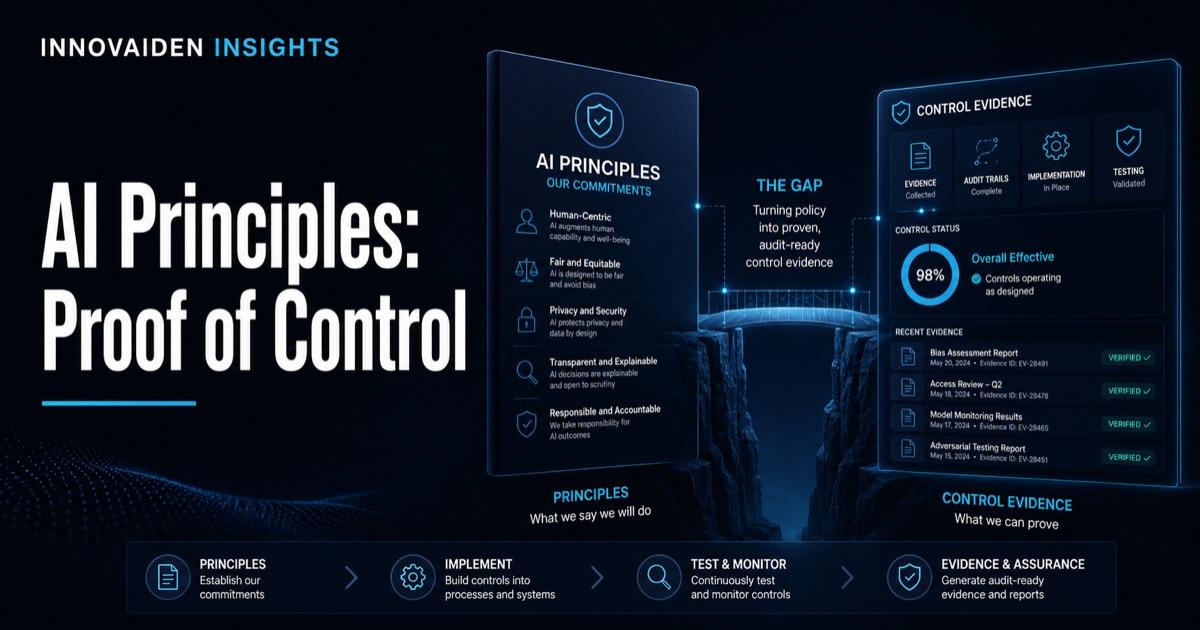
Boards have spent the last 18 months approving AI principles. The next 18 months will be about proving those principles operate as controls. The question is no longer "do we have a policy." It is "can you demonstrate that the policy is enforced." The gap between those two questions is where reputational and regulatory risk sits.
Key Takeaways
- Only 37% of organizations have AI governance policies in place; fewer still have operational controls enforcing them
- 78% of organizations lack formal policies for creating or removing AI identities
- 92% of organizations lack confidence that their legacy IAM tools can manage AI risks
- The EU AI Act high-risk obligations now apply 2 December 2027 (Annex III) and 2 August 2028 (Annex I) under the Digital Omnibus deferral, with penalties up to 3% of global annual turnover; the Commission's 19 May 2026 draft Article 6 guidelines set the classification interpretation supervisors will use
The Gap Between Stated Principles and Daily Reality
Most AI principle documents contain variations of the same five commitments: human oversight, transparency, fairness, security, accountability. These are good principles. They are also the same principles that, in organizations that have experienced AI incidents, were in place on the day the incident happened.
The gap is not the principles. It is the evidence that the principles have teeth. A principle with teeth has three attributes: it translates into a specific control, the control operates without human intervention, and the operation is logged so it can be audited. A principle without teeth is a sentence. For organizations that are building the runtime controls that convert principles into enforcement, the evidence framework below is what makes those controls auditable.
What Meaningful Evidence Looks Like
Three categories of evidence, in combination, move a board from trust to verification:
| Evidence Category | What It Proves | What "Good" Looks Like |
|---|---|---|
| Logs | AI interactions are captured and reviewable | Every material AI interaction logged, showing who requested what, which system responded, what was returned, and whether policy rules triggered. Retained for a defined period. Reviewable on demand. |
| Approvals | High-impact AI decisions have accountability | Every decision to train a new model on internal data, deploy an agent with production access, or grant elevated permissions has a trail naming the approver, date, scope, and expiration. "We authorized this in a meeting" is not an approval trail. |
| Red-team reports | AI systems have been tested for failure modes | At least annually, AI systems are tested by a team (internal or external) whose job is to find failures. Report delivered, findings prioritized, remediation tracked. If the red team surfaces no findings, either the AI surface is too limited or the red team is not competent. |
Three Artifacts the Board Should Expect Quarterly
The AI inventory. Count of AI systems, count of agents, count of non-human identities tied to AI. Trend over time. Any material additions flagged. For how AI agent identity management creates the inventory that feeds this artifact, the identity register is the foundation.
The incident log. All AI-related incidents detected in the quarter, whether they resulted in disclosure or not. If the number is zero, a note on detection coverage that would surface an incident if one occurred. For how shadow AI creates incidents that most organizations cannot detect, the incident log needs to cover both governed and ungoverned AI.
The control-effectiveness report. For the top five AI governance controls (defined by the organization), the result of the most recent test of each. Pass, partial, or fail. Remediation timeline for any below pass.
These are not complicated artifacts. They are, however, the artifacts that separate organizations with runtime AI governance from organizations with a PDF. For the convergence of AI, cybersecurity, and regulatory requirements, these quarterly artifacts address all three domains simultaneously.
What Happens When the Evidence Is Absent
Three things, in sequence. First, the organization cannot answer the question when regulators ask. Second, when an incident happens, the legal and regulatory posture is weaker because the absence of evidence is itself evidence. Third, the insurance cost increases because the cyber insurance market is explicitly pricing AI governance maturity into premiums.
The cost of producing the evidence is lower than the cost of not having it.
The Board AI Evidence Pack includes the quarterly artifact templates, the control-effectiveness testing methodology, and a readiness self-assessment for EU AI Act enforcement — including the Article 6 classification rationale supervisors now expect under the Commission's 19 May 2026 draft guidelines. For the full read of the draft and what it changes for the evidence pack, see the EU's high-risk AI filter: inside the May 2026 draft guidelines.
Build Your AI Evidence Pack
Innovaiden works with leadership teams deploying AI agents across their organizations, from initial setup and training to security framework alignment and governance readiness. Reach out to discuss how we can help your team.
Get in TouchFrequently Asked Questions
What is the difference between AI principles and AI controls?
A principle is a statement of intent ('employees must not submit confidential data to unapproved AI tools'). A control is a mechanism that enforces the principle at runtime without requiring human intervention (a DLP rule, a browser policy, a network block). A principle with teeth has three attributes: it translates into a specific control, the control operates automatically, and the operation is logged for audit.
What three categories of evidence prove AI governance is operational?
Logs (every material AI interaction captured, showing who requested what, which system responded, what was returned, and whether policy rules triggered), approvals (documented trail for high-impact AI decisions with named approver, date, scope, and expiration), and red-team reports (at least annual testing of AI systems by a team tasked with finding failure modes, with findings tracked to remediation).
What three artifacts should boards expect quarterly on AI governance?
The AI inventory (count of systems, agents, and non-human identities, with trend over time). The incident log (all AI-related incidents detected, whether they resulted in disclosure or not). The control-effectiveness report (results of the most recent test of top five AI governance controls, with pass/partial/fail rating and remediation timelines).
What happens when AI governance evidence is absent?
Three consequences in sequence: the organization cannot answer when regulators ask, the legal and regulatory posture weakens when an incident happens because absence of evidence is itself evidence, and insurance costs increase as the cyber insurance market explicitly prices AI governance maturity into premiums.
What regulatory deadlines make AI proof-of-control urgent?
Under the Digital Omnibus on AI, EU AI Act high-risk obligations now apply 2 December 2027 for Annex III use cases (Article 6(2)) and 2 August 2028 for Annex I product-route systems (Article 6(1)), with penalties up to 3% of global annual turnover for high-risk violations. The Commission's 19 May 2026 draft Article 6 guidelines set the working interpretation supervisors will use — the evidence pack now has to support the classification claim itself, not just the post-classification controls. NIS2 is now in force in Sweden and most EU member states, adding supervisory expectations for AI systems with access to network and information systems. Organizations with runtime governance have audit-ready answers. Organizations with principles have a PDF.
Related Insights
Sources