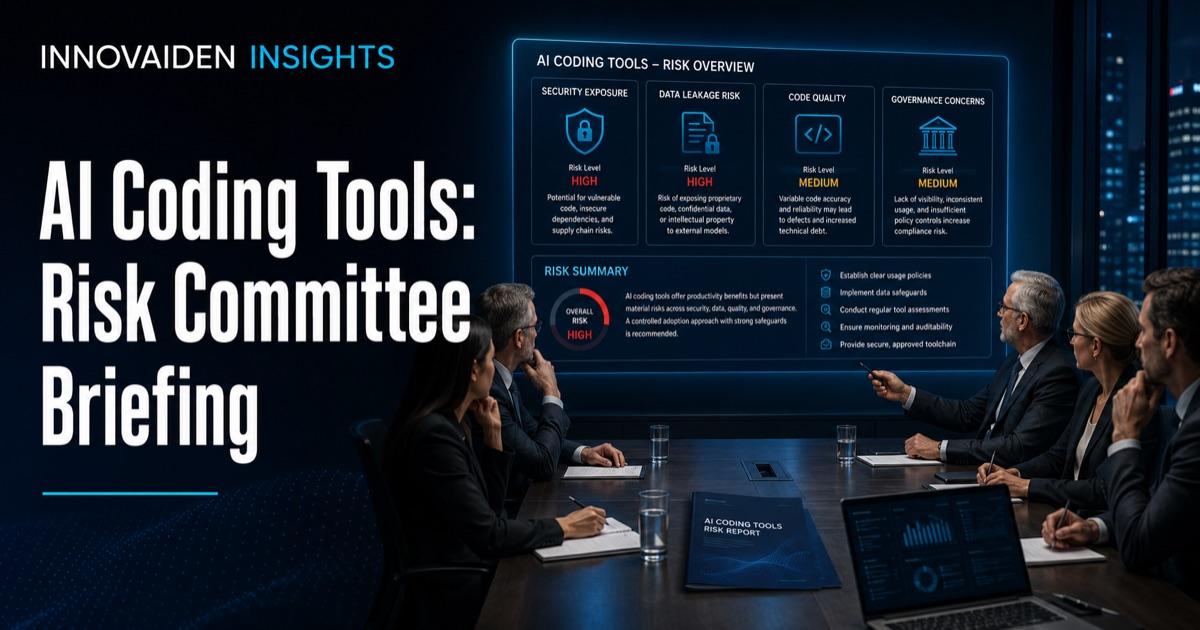
AI coding tools are being adopted faster than any technology category since cloud computing, and the adoption is largely happening below the committee line of sight. The tools are procured team by team, enabled in existing SaaS without a new approval, and embedded in developer workflows before governance has a structured view of the exposure.
Key Takeaways
- 83% of organizations plan to deploy agentic AI; only 29% feel ready to do so securely
- 73% of production AI deployments have exploitable prompt injection vulnerabilities
- Multiple 2026 incidents (RoguePilot, CamoLeak, Comment-and-Control) demonstrate real exploitation at CVSS 9.4 to 9.8 severity
- 97% of non-human identities, including those used by AI coding agents, have excessive privileges
Why AI in Development Is Both Accelerator and Risk Multiplier
The productivity case is real. Code suggestions, test generation, documentation, and routine refactoring can genuinely reduce engineering time. For an organization with 200 engineers at a loaded cost of $250,000 per year, a 10% productivity improvement is $5 million annualized. The business case is not the problem.
The risk case is that an AI agent in the development environment has the same file system access, shell execution privileges, and database credentials that the developer does, without the same judgment, training, or accountability. When the AI is induced to take a malicious action (through prompt injection, supply chain compromise, or credential leakage), the resulting incident is indistinguishable from a trusted insider attack. For the technical details on how these attacks work in practice, the real 2026 CVEs demonstrate that these are not theoretical risks.
Three Questions to Ask Management
| Question | What "Good" Sounds Like | Red Flag |
|---|---|---|
| Which AI coding tools are authorized, and under what conditions? | A specific list with conditions per tool | "Developers can use approved tools" without naming the list or who maintains it |
| What is the permission model for AI agents in the development environment? | "No agent has access to production credentials, with documented controls" | Any answer suggesting agents share developer-level access to production |
| How are AI-related security incidents detected and reviewed? | Described detection for prompt injection, credential leak, and unauthorized agent actions | Cannot describe what detection looks like for AI-specific attack patterns |
What the Latest Data Says
Two reference points published in late April 2026 sharpen the committee conversation. ProjectDiscovery's 2026 AI Coding Impact Report found that AI-generated code is being merged faster than security teams can review it, and that the share of S&P 500 companies disclosing AI risk in their annual filings rose from 12% in 2024 to 83% in 2026 — a year-over-year shift that maps directly to risk-committee territory. Cursor CVE-2026-26268, disclosed in late April, lets a malicious repository's Git hook execute arbitrary code on a developer's machine when the AI agent autonomously runs Git operations — joining RoguePilot and CamoLeak as a third named SDLC-level AI coding exploit.
For the committee, the implication is concrete: this is no longer a category where "we're tracking it" passes. The risk has named CVEs, a documented disclosure-to-filing pattern, and S&P 500 peer disclosures the board can be benchmarked against.
Tracking Safe Productivity, Not Just Volume
The temptation is to measure AI adoption by volume: how many PRs include AI-generated code, how many hours of engineering time have been freed. These metrics are not wrong, but they do not capture the risk side.
A more complete metric set includes: the count of AI-agent-originated PRs merged without human review (should trend to zero), the count of AI-agent credentials in rotation (should trend upward as static tokens are replaced with short-lived ones), and the count of AI-related security incidents detected and contained (should be non-zero in any organization with real visibility, because if the metric is zero, it usually means the organization is not detecting them).
What Committees Should Expect Quarterly
A single slide showing four things: the sanctioned AI coding tool inventory, the AI agent identity count and permission status, the count of AI-related security incidents and their outcomes, and any material changes to the risk posture in the prior quarter. If management cannot produce this slide, the committee does not have oversight of this category. For how boards should approach the broader AI agent question, the coding-tool briefing is a subset of the same governance challenge.
The Committee Briefing Pack includes the metric definitions, the quarterly report template, and the three-question assessment framework.
Get the AI Coding Tools Committee Briefing
Innovaiden works with leadership teams deploying AI agents across their organizations, from initial setup and training to security framework alignment and governance readiness. Reach out to discuss how we can help your team.
Get in TouchFrequently Asked Questions
Why are AI coding tools a risk committee concern?
AI coding tools are being adopted faster than any technology category since cloud computing, and the adoption is largely happening below committee line of sight. The tools are procured team by team, enabled in existing SaaS without a new approval, and embedded in developer workflows before governance has a structured view of the exposure.
What is the business case versus the risk case for AI coding tools?
The productivity case is real: for an organization with 200 engineers at a loaded cost of $250,000 per year, a 10% productivity improvement is $5 million annualized. The risk case is that an AI agent in the development environment has the same file system access, shell execution privileges, and database credentials as the developer, without the same judgment, training, or accountability.
What three questions should risk committees ask management?
Which AI coding tools are authorized, and under what conditions (a list, not a posture). What is the permission model for AI agents in the development environment (specifically: do agents have access to production credentials). How are AI-related security incidents detected and reviewed (if the organization cannot describe detection for prompt injection, it cannot claim coverage).
What metrics should committees track for AI coding tool safety?
Count of AI-agent PRs merged without human review (should trend to zero), count of AI-agent credentials in rotation versus static tokens (should trend upward), and count of AI-related security incidents detected (should be non-zero in any organization with real visibility, because zero usually means not detecting rather than not occurring).
Related Insights
Sources
- OWASP - 2026 Top 10 for LLM Applications
- Entro Security - 2025 State of Non-Human Identities
- Orca Security - RoguePilot Vulnerability Disclosure, February 2026
- Legit Security - CamoLeak Disclosure
- ProjectDiscovery — 2026 AI Coding Impact Report. April 2026.
- Novee Security — Cursor CVE-2026-26268. April 2026.